Brigham Young University Homepage

Physics & Astronomy

Graduate Program

Featured Research
First Light for the BYU 0.9-m Telescope
This image was secured during the installation of the 0.9-m telescope at the BYU West Mountain Observatory. Data for this image is from August 27, 2009. This was the first night that a CCD had been mounted on the telescope so that imaging was possible. This 'First Light' image shows the globular cluster known as M15 in the constellation of Pegasus. The distance to this cluster is more than 33,000 light years and yet individual stars are easily resolved all through the cluster. Globular cluster stars have an extremely low abundance of heavy elements as compared to stars found in the solar neighborhood and represent the oldest population of stars known in the Galaxy. It is interesting to note the many cool red giant stars that are visible in the cluster as well as a large number of evolved horizontal branch stars that are blue in color. Many of the horizontal branch stars are known to be RR Lyrae variable stars that are useful as distance indicators since it is possible to determine their luminosity and compare that value to their apparent magnitude as measured from the observed images. The color image processing for this picture is the work of Dr. Rob Gendler. Dr. Gendler is well known for producing amazingly detailed astronomical images that are often featured on the Astronomy Picture of the Day. [Read More]

Interested in coming here?

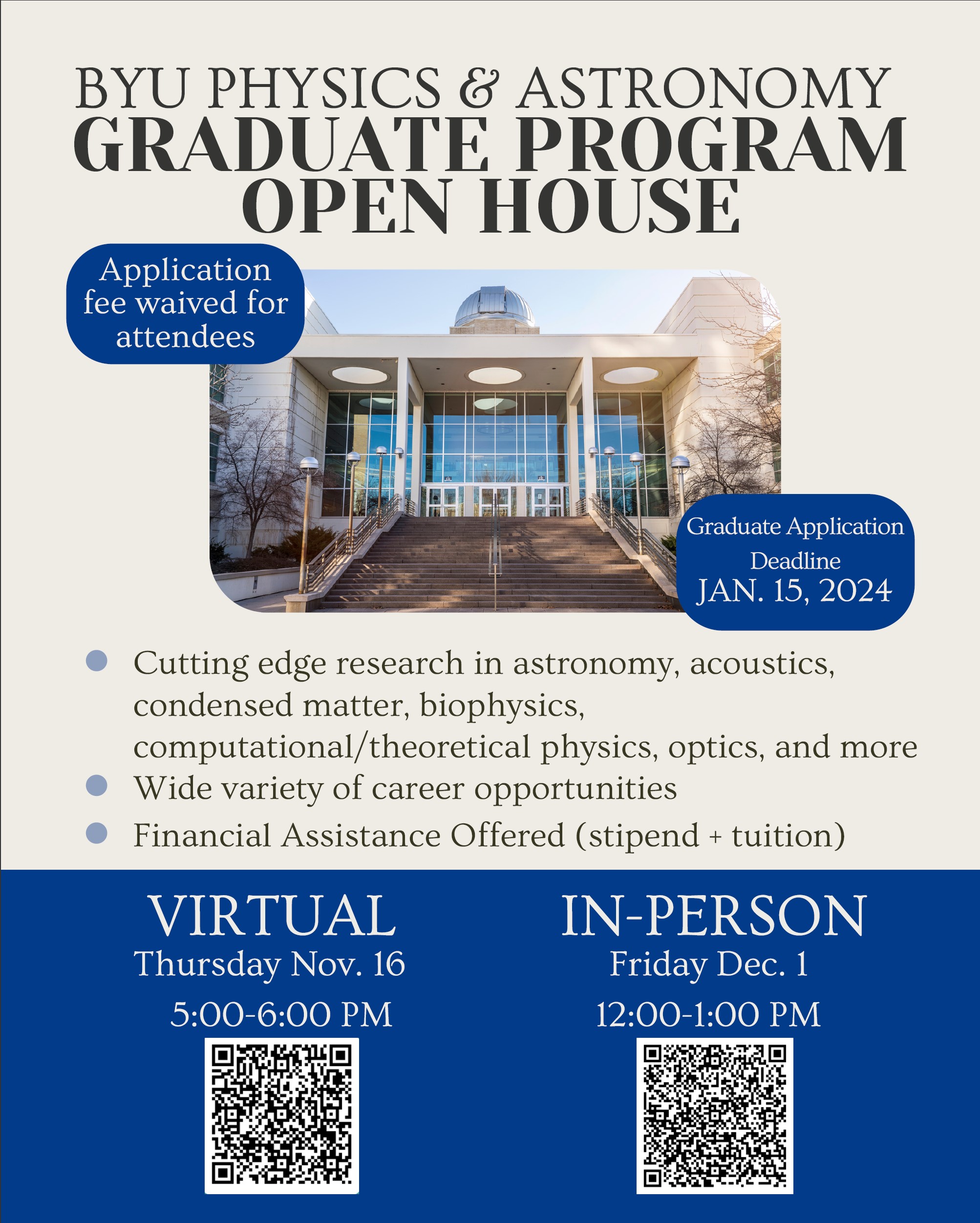
Please register your interest via this short form.

About the Program
The Physics and Astronomy Department at Brigham Young University is part of BYU's graduate program.
Research Opportunities
There are many opportunities for research in Physics and Astronomy in six general areas of research.
Financial Assistance
Financial assistance is available to the qualifying graduate student.
How to apply
We encourage all who are seriously contemplating coming to BYU for graduate work to read the Guide for Applying to Graduate Study.
Life at BYU
Utah is a great place to live! Here are just a few of the attractions to be enjoyed near BYU.
Current students
Take a look at the current students and learn about their research and interests.
Contact Us
Get a hold of the departmental Graduate Committee that oversees the Physics and Astronomy graduate program.

Decided to come here?

Departmental Expectations
The Department of Physics and Astronomy is committed to the success of all students admitted.
General Degree Requirements
Specific requirements for each of the graduate degrees are described here.
How to Get Started
Congratulations! You've decided to come to BYU! What comes next?

Already here?

Major Milestones
To make progress on your graduate student track, there are a number of milestones you must cross along the way.
Evaluation and Progress
Students should not jeopardize their investment of time and resources by dragging out the time to graduate!
M.S. to PhD Transition
If you are accepted into our MS program, it is possible to transition into the PhD program. Here are the steps you must take.
 
The Church of Jesus Christ of Latter-day Saints | BYU-Hawaii | BYU-Idaho | BYU Jerusalem Center | BYU Salt Lake Center | LDS Business College | Missionary Training Center