Brigham Young University Homepage

Physics & Astronomy

Colton Research Group

Overview

Spintronics/Quantum Computing

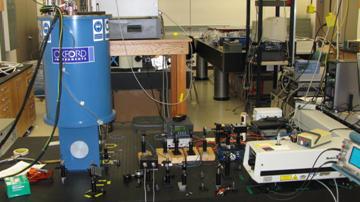
Inside our research lab. Spin states of electrons in semiconductors have been the focus of much recent research due to the twin emerging fields of spintronics and spin-based quantum computing. Spintronics involves actively using the spin of an electron together with its charge in the operation of nanoscale electronic devices. Interesting applications of spintronics include giant magneto-resistance (GMR), the discovery of which was awarded the 2007 Nobel Prize in Physics and which now is used extensively in hard disk read heads; magnetic random access memory (MRAM) a non-volatile memory now being used in applications such as computers in satellites; and spin-LEDs, which are light-emitting diodes that produce circularly polarized light by orienting the spin of the electrons inside the diode structure.

Spin-based quantum computing involves using quantum mechanical spin states as the "1"s and "0"s of a computer for storage and calculation. Quantum computers will use these states and quantum mechanical operations to solve certain kinds of problems exponentially faster than classical computers. Examples of such problems include database searching and the cryptographic task of factoring large numbers into primes. Using the spin states of electrons in semiconductor nanostructures for the quantum-mechanical bits (qubits) of such a computer was first proposed in 1998, and has been the subject of much theoretical and experimental research ever since.

For electrons to be used in qubits and spintronic devices, their spin states must be controllable. Undesired interaction with environmental factors such as nuclear spins and phonons can lead to decoherence. To prevent unwanted changes to qubits, this decoherence must be small enough that it does not irreversibly affect the quantum state of the computer on the time scale of the computing operations. In order for spin-based nanosystems to function, they must therefore be implemented in materials which have relatively long spin lifetimes. Finding out which materials have the best spin dynamic properties will help characterize materials for spintronic and quantum computing applications. We propose to study the spin dynamics of several spintronic and quantum computing-related nanostructure systems, using combined optical and microwave techniques.

Spin Lifetimes

The spin dynamics of a system are often described using one of three common lifetimes, labeled T1, T2, and T2*. T1 is the "longitudinal" or "spin flip" time, describing how fast spins flip their direction parallel or anti-parallel to an applied magnetic field. The energy level splitting is: ΔE = gμBB, where μB is the Bohr magneton and g is the electron g-factor for the particular material. Changing the direction of a spin in the presence of a magnetic field requires addition or subtraction of some energy; consequently T1 is typically the longest of the three times for a given material.

T2 is the "spin coherence" or "spin dephasing" time, which describes the coherence of an ensemble of spins. The decoherence described by T2 sets the time scale for potential quantum computing—many calculations will need to be done within the T2 time of the quantum computing material. T2 is also called the transverse relaxation time and is typically the most difficult of the three times to quantify. Because there is no energy difference in the transverse direction, T2 is typically shorter than T1.

T2* is the "inhomogeneous dephasing" time. It describes the apparent dephasing produced by inhomogeneous effects in the material. If the spins behave slightly differently in different places in a material (e.g. have slightly different g-factors), they get out of phase with each other. This is independent of, and cumulative with, the effects which produce T2-type decoherence; thus this is the shortest spin lifetime. Inhomogeneous effects can be compensated for through special techniques such as the spin echo, but if no such techniques are employed, T2* will be measured instead of T2. T2* provides a lower bound for T2.

For more information, please see this discussion of semiconductor spin lifetimes and decoherence by Michael Flatté at the University of Iowa.

Optical Study of Spin

In most III-V semiconductors, the spin states are connected to optical transitions via selection rules. This allows one to study the spins in these materials via optics: optically exciting the spins into desired states and/or detecting the state of the spins by measuring optical properties. In the important material GaAs, for example, spin coherence properties have been studied through the following optical methods (not an exhaustive list):

(a) The Hanle effect. This is a method of finding the T2* spin lifetime by measuring the depolarization of luminescence in a transverse magnetic field. In this technique the spins are oriented using circularly polarized light and their states are monitored via the polarization of the emitted light. As the field is increased from zero, the spins precess away from their initial direction, which causes the emitted light's polarization to change. The T2* lifetime is deduced from the width of the depolarization vs. field curve.

(b) Time-resolved Faraday or Kerr rotation. This is also a measurement of spin precession, typically done at higher fields, which like the Hanle effect can yield T2* spin lifetimes. In this technique, the sample is typically excited with a short pump beam of circularly polarized light, after which the spin states are monitored via the Faraday or Kerr effects acting on a linearly polarized probe beam. The Faraday (for transmitted light) and Kerr (for reflected light) effects cause the probe beam's angle of polarization to change in response to the overall spin polarization of the electrons in the sample. The precession of spins due to a transverse external field can be seen directly as oscillations in the Faraday rotation as one varies the time delay between pump and probe beams.

(c) Time-resolved decay of polarization. This is a measurement of spin decay that yields T1. In this technique, spins are first injected parallel to an external magnetic field through an optical pump pulse. The state of the spins some time later is measured by an optical probe pulse. The change in spin states between the two pulses is due to spin flip events, and the spin polarization decays according to the spin flip time.

When applied to n-type bulk GaAs samples, these optical techniques have resulted in experimental measurements ranging from 5-200 ns for T2*, and 0.04-20 μs for T1,  depending on details such as sample doping level, temperature, and magnitude of external magnetic field. Overall these values agree fairly well with spin properties measured through other methods and those predicted theoretically.

Spin Resonance

Optical methods are not the only options for studying spin. Microwave techniques in particular have been used for years to study the spin of electrons. The microwave studies of spin center around the principle of magnetic resonance: transitions between the two spin-split energy levels of the electrons can be induced when microwaves with the corresponding energy are applied. The resonant microwave frequency f is given by the condition: hf = ΔE = gμBB. When the spins are manipulated in a standard magnetic resonance experiment (also called "electron spin resonance," ESR), the widths of the resonance peaks depend on the spin lifetime and can be an additional method for obtaining T2*.

More important, however, is the potential for coherently rotating the spins in a controlled fashion via pulsed microwaves. As an intense resonant microwave field is applied, the electrons are driven back and forth between spin states; these are Rabi oscillations. By interrupting the oscillation cycle and applying pulses of varying strengths at various time delays, the electrons'spins can be rotated to arbitrary directions. In these resonance experiments, the microwaves are directly and controllably manipulating the electrons'spin. In the quantum computing context, these would be called one qubit operations, which are needed in all quantum computing implementations. Through clever pulse sequences, additional spin dynamic information can be obtained; the Hahn spin echo is one such sequence and is the usual method for determining the spin coherence time T2.

Combined Optical/Microwave Techniques

Traditional microwave experiments detect the absorbed microwave power; these experiments are not feasible in nanostructures because there are not enough spins in the material to produce a measureable effect. However, microwave resonance can be combined with optical detection to dramatically increase the sensitivity of spin resonance experiments. This technique, called "optically detected magnetic resonance" (ODMR) has been successfully applied to semiconductors for many years. Under the proper conditions, optical detection schemes can even allow one to detect the state of individual spins, as has been done with the NV-center defect in diamond.

Summary

The study of spin dynamics in semiconductors is extremely important given the potentially transformative effects from spintronics and quantum computing. Optical methods have proven successful at studying electron spins in GaAs and related materials; microwave resonance techniques also have a long history of success. We propose to combine both in order to study the spin dynamics of several important semiconductor nanostructure systems.

The Church of Jesus Christ of Latter-day Saints | BYU-Hawaii | BYU-Idaho | BYU Jerusalem Center | BYU Salt Lake Center | LDS Business College